The Collaborative Action Model:
A Framework for Moving Collaborative Work from Possibility to Impact
Collaboration is a process.
When organizations come together to explore shared work—whether that’s aligning programs, launching a collective initiative, or considering a full-blown merger—too often they rush to solutions before understanding the terrain. That’s why I developed the Collaborative Action Model.
The Collaborative Action Model is a five-phase framework that helps leaders design collaborative initiatives with intention and clarity to build momentum. Rather than treating collaboration as a single event, it recognizes collaboration for what it is: a journey that unfolds through a series of distinct, interconnected phases.
Below, I highlight the goals, key principles, common pitfalls, and tools and strategies to bring each phase of the Collaborative Action Model to life.

Introducing the Collaborative Action Model
The Collaborative Action Model is a five-phase framework that helps leaders design collaborative initiatives with intention and clarity to build momentum. Rather than treating collaboration as a single event, it recognizes collaboration for what it is: a journey that unfolds through a series of distinct, interconnected phases.
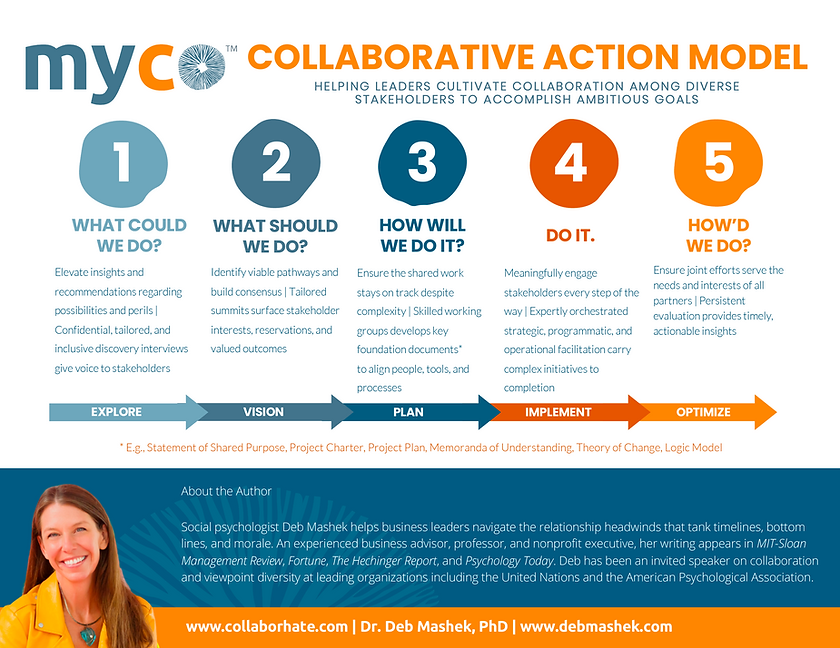
Collaboration Is a Process
One of the biggest mistakes I see is treating collaboration as though everyone is asking the same question at the same time.
They're not.
Early in a collaboration, the most important question is, What could we do?
Later, it becomes, What should we do?
Only after that does it make sense to ask, How will we do it?
And even once the work is underway, the questions continue to evolve.
Each phase of the Collaborative Action Model prepares the group for what comes next.
The Five Phases of the Collaborative Action Model
Phase 1: What Could We Do?
Goals:
-
Elevate insights and recommendations regarding possibilities and perils
-
Give voice to stakeholders
Key principles:
-
Truly exploratory
-
No right answers
-
Broad inclusion
-
Confidentiality
Common pitfall:
-
Loud voices
Tools and strategies:
-
1:1 Discovery interviews
-
Small-group listening sessions
-
Anonymous surveys

Phase 2: What Should We Do?
Goals:
-
Identify viable pathways and build agreement
-
Surface stakeholder interests, reservations, and valued outcomes
Key principles:
-
Narrow down from many options
-
Align with mission, vision, values
-
Align with strategic plan
-
Clarify decision making authority
Common pitfall:
-
Cabals and rooting interests
-
Last-minute veto power
-
Performative inclusion
Tools and strategies:
-
Remove non-starters
-
Charrettes
-
Summits
-
Retreats

Phase 3: How Will We Do It?
Goals:
-
Ensure the shared work stays on track despite complexity
-
Align people, tools, and processes
Key principles:
-
Specify, specify, specify
-
Onboard needed resources
-
Write it down, share it out
Common pitfall:
-
Vague descriptions invite different understandings
Tools and strategies:
-
Skilled working groups
-
Foundation documents:
-
Statement of Shared Purpose
-
Project Charter
-
Project Plan
-
Memoranda of Understanding
-
Theory of Change
-
Logic Model
-

Phase 4: Do It.
Goals:
-
Meaningfully engage stakeholders every step of the way
-
Carry complex initiatives to completion
Key principles:
-
Moving from ideas to action
-
Project management
-
Transparency and communication
-
Clarity and coherence
-
Maintain momentum
Common pitfalls:
-
Missions drift
-
Momentum stalls
-
Partners disappear
-
Balls get dropped
Tools and strategies:
-
Strategic, programmatic, and operational facilitation
-
Project management
-
Communication plan (including dashboards)

Phase 5: How'd We Do?
Goals:
-
Ensure joint efforts serve the needs and interests of all partners
-
Obtain timely, actionable insights
Key principles:
-
Proactive
-
Include a range of voices
-
Early detection
-
Continuous improvement
Common pitfall:
-
Misinterpreting silence as meaning all is well
Tools and strategies:
-
Informal evaluation
-
Formal evaluation
-
Listening
-
Course correction, if needed

Why Sequence Matters
The Collaborative Action Model isn't simply a checklist.
It's a sequence.
Each phase creates the conditions needed for the next.
When organizations begin with careful discovery, they're better positioned to make thoughtful decisions. When decisions are clear, designing the collaboration becomes easier. When the infrastructure is strong, implementation is more likely to succeed. And when collaborators regularly reflect on what's working—and what isn't—they're able to strengthen both the work and the relationships over time.
That said, the process isn’t always linear. Sometimes, collaborators realize they need to repeat a step to ensure everyone is on the same page.
Designed for Complex Collaboration
I've used the Collaborative Action Model with foundations, nonprofits, higher education institutions, cross-sector partnerships, professional associations, and networks tackling complex challenges that no single organization could solve alone.
While every collaboration is unique, the questions leaders must answer are remarkably consistent.
The Collaborative Action Model offers a practical roadmap for navigating those questions, helping collaborative efforts move from possibility to purposeful action, and from purposeful action to lasting impact.
If you're designing a collaborative initiative, the Collaborative Action Model provides a shared language, a practical structure, and a roadmap for moving important work forward, together.
Questions to Consider
-
Where have you seen organizations skip important conversations in collaborative action? What were the consequences?
-
What collaboration challenges or frustrations have you noticed in your key projects? How do these challenges relate to ideas from the Collaborative Action Model?
-
How might you, your team, or organization apply one or more ideas from the Collaborative Action Model to strengthen a current or upcoming initiative?
-
What barriers or resistance might one encounter when implementing ideas from the Collaborative Action Model?
Citation
Mashek, D. (2021). The Collaborative Action Model. Myco Consulting LLC.
Explore More Resources


